
Lara Cornejo
Hace muchos años viajé por Querétaro (México) buscando cactus. En aquella época me dedicaba de tiempo completo al cultivo y la venta de cactáceas en invernadero y pasaba mis días en el sol, entre la tierra y las espinas. Una parte importante de mi trabajo incluía conocer el hábitat natural de las especies que comercializábamos en el vivero, y por eso frecuentemente emprendía viajes exploratorios a campo. Querétaro es un estado semi-desértico y es un punto de alta diversidad y endemismos de cactáceas, esto quiere decir que, en comparación con otros estados mexicanos, Querétaro tiene más especies de cactus y muchos de ellos sólo se distribuyen ahí.
Ariocarpus kotschoubeyanus
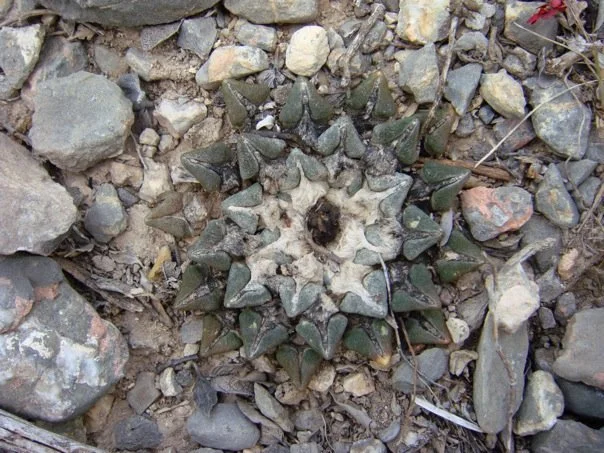
Acostumbrada a ver plantas bien cuidadas en las macetas y los jardines del vivero, poco imaginaba yo de los ambientes inhóspitos en donde éstas curiosas plantas habitan. Durante ese viaje, varias veces me encontré caminando en llanos pedregosos volteando al piso desilusionada por no encontrar ninguna planta. Tuve que arrodillarme y casi pegar la cara al suelo para poder verlo, y fue muy curioso, porque una vez que encontré uno el resto fueron apareciendo casi mágicamente por el camino. El Ariocarpus estaba ahí, rodeado de piedras y ramitas, prácticamente enterrado, como si se estuviera escondiendo. A esta especie (A. kotschoubeyanus) le dicen “pata de venado” (en la foto pueden ver por qué), pude ver varios más al rededor, la colina donde los encontramos era plana y gris, seca y solitaria, ¿qué otras cosas esconderían ese desierto? Se estaba haciendo tarde, pero estábamos muy cerca de la localidad de otro cactus, teníamos que apurarnos si queríamos aprovechar la luz del sol antes de regresar al pueblo donde nos estábamos quedando. Cuando llegamos al sitio pude notar que la tierra ahí era de un color diferente, más blanca y menos compactada. Esta vez teníamos que buscar en las laderas del cerro y cerca de las barrancas, pues esta planta crece en sitios con mucha pendiente. El acceso no era fácil, pues había que caminar pegados a la pared del cerro y mantener el equilibrio para no derrapar y caer por la barranca. ¿Estaba yo segura de que quería encontrar ese cactus? ¿valía la pena arriesgarme? ¡Claro que sí! Además, mi destreza y agilidad me permitirían explorar fácilmente esa ladera.
Strombocactus disciformis
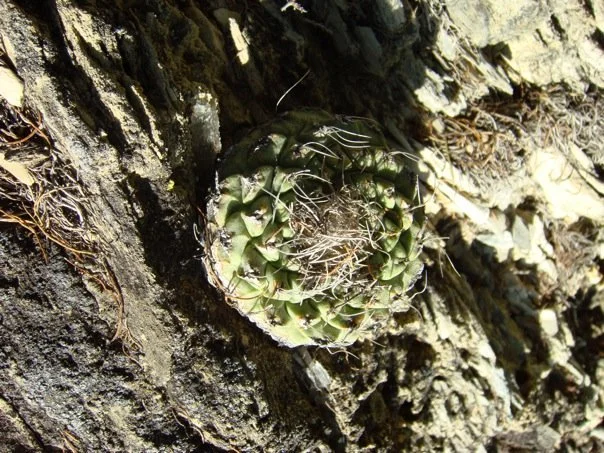
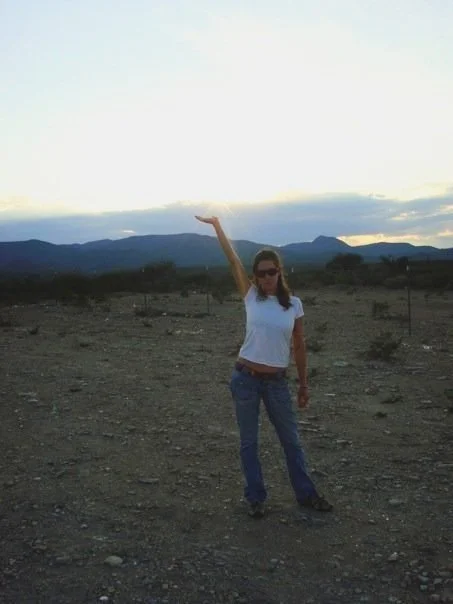
En ese momento no imaginé ningún inconveniente y me concentré en recorrer la ladera cuidando cada paso. Y entonces, debajo de un arbusto los encontramos, ahí estaban los “cactus trompo” (Strombocactus disciformis) de espinas muy delgadas y color verde pálido, prácticamente creciendo entre las piedras de la ladera, muy intrépidos y autosuficientes. Les tomé fotos y me sentí satisfecha, había sido un buen día. Para mantener mi equilibrio y salir de ahí me sujeté de uno de los arbustos mientras avanzaba por la ladera, de pronto sentí como si me hubieran arrojado una piedra en la cabeza, y luego otra, volteé a todos lados y no vi nada, al cubrir mi cabeza con la mano sentí otra “pedrada” en uno de mis dedos, “¡¿qué es esto?! ¡alguien me ataca!”. Desde arriba de la ladera escucho que me gritan: “¡Moviste el arbusto y hay un panal de avispas dentro! ¡Sal de ahí ya!”. Me puse muy nerviosa porque no quería caer al barranco, tampoco quería seguir cerca del arbusto traicionero pero no podía correr para salir de ahí y estaba rodeada de avispas indignadas que defendían su barrio con toda fiereza. Como pude me pegué a la ladera y logré escapar, pero no sana y salva. Al subir al carro me dolían la cabeza y el dedo. Estábamos en una zona remota y solitaria, el día llegaba a su fin y todavía teníamos que recorrer un buen camino para llegar al pueblo. Mi dedo se inflamó de manera preocupante mientras yo pensaba “¿Seré alérgica a las avispas? ¿será grave la picadura en mi cabeza? ¿llegarán más rápido las toxinas a mi cerebro? ¿y si entro en shock? ¿se me va a caer el dedo? ¿voy a morir aquí en medio del desierto?”. Continuamos el trayecto en silencio mientras yo seguía encerrada en pensamientos catastróficos “¿cuánto tiempo tiene que pasar para saber que estás entrando en shock? ¿a los cuántos minutos de exposición se te cierra la garganta? ¿tendré que ir al hospital? ¿por qué no traigo un kit de primeros auxilios? Ni siquiera una pinche aspirina tengo”. Un momento después me di cuenta de que no soy alérgica a las avispas. No me pasó nada. El dolor disminuyó al poco tiempo y no presenté ninguna reacción. No se me cayó el dedo ni murieron mis neuronas. Les dejo las fotos de los cactus y de la sobreviviente después de su aventura. No son las mejores fotos, pero son mías y siempre me recordarán el día en que no me mataron las avispas.
PD. No sean como yo y lleven siempre consigo un kit básico de primeros auxilios, no importa que sus viajes no sean muy largos, o si son de trabajo o paseo relajado. No podemos predecir qué pasará en campo, pero lo que sí es seguro es que en algún momento nos toparemos con la furia de la naturaleza.
Years ago I traveled through Queretaro (Mexico) on a cactus quest. During those years I was working full time growing and selling greenhouse-cacti and used to spend my days under the sun, surrounded by dirt and thorns. An important part of the job consisted in visiting the natural habitat of some of the species we sold at the nursery, and short exploration field trips were common. Queretaro is a semi-desert state and it’s a hot-spot of cacti richness and endemic species, which means that compared to other Mexican states, Queretaro holds a great number of cacti species and many of them can only be found there and nowhere else.
I was used to seeing pot-grown plants at the nursery, so I didn’t quite imagine the wild and hostile natural habitats where these funny plants dwell. During that trip, I was often disappointed when I looked for cacti in the great rocky valleys and found none. I had to kneel down and put my face in the ground to be able to finally see it, and curiously enough, once I found one, many others started popping up along the road, almost magically. I spotted a solitary and very special Ariocarpus, surrounded by pebbles and leaves, practically buried, hiding. This species (A. kotschoubeyanus) is known as “deer hoof” (you can find out why by looking at the photo), I found many others in the surroundings, on a flat, gray, dry, and lonely hill. What other things was this desert hiding?.
It was getting late but we wanted to look for another species at a spot nearby, we had to hurry up to make the most of the afternoon and get back to town. When we got to the spot I noticed the dirt there was different, whiter and loose. This time we had to look on the side of a hill and near the gullies because this species grows on steep slopes rather than flat ground. Access to the slope was not easy, we had to walk on the edge and close to the hill wall to keep balance and not fall into the canyon. Was I sure I wanted to find this cactus? Was the risk worth it? Hell yeah! Besides, I’m agile enough to overcome this. I felt confident and safe and was focused on walking carefully. Finally, we found it under a bush, there it was, the very intrepid “spinning top cactus” (Strombocactus disciformis) with its long gray spines, practically growing between the rocks on the slope. I took some photos of it and felt happy and satisfied, it had been a good day. In order to keep my balance and go back the way I came I held to one of the bushes as I moved through the hill when all of the sudden I felt a sharp strike on my head, I looked up and saw nothing, covered my head with my hand and felt another strike, this time on my finger “What is this?! Someone is attacking me!”. From up the slope, I could hear someone yelling “There are wasps on the bushes! Get out of there fast!”. I got really nervous and worried about losing my balance, I didn’t want to get near the treachery bushes either, I couldn’t run, and I was surrounded by angry gangster-style hood-protecting wasps. I managed to stay close to the slope and escape, although not sound or safe. Once in the car, I could feel the acute pain in my head and finger. We were in a remote area and still had a long way back to town. My finger started swelling and my worries too “Am I allergic to wasps? Is the stung on my head so bad that toxins will get to my brain faster? Will I go into shock? Will I lose my finger? Will I die here today in the middle of this desert?”. We continued the trip in silence while my catastrophic thoughts grew “How long before entering shock mode? How long before my throat closes? Will I need a hospital? Why didn’t I bring a first aid kit? Not even aspirin, nothing”. A short moment later I realized I’m not allergic to wasps. Nothing happened. The pain went away and I didn’t have any bad reaction. I didn’t lose my finger or my brain cells. I leave you with some photos of the nice plants and the survivor, they are not the best photos but they are mine and they will always remind me of the day I wasn’t killed by wasps in the desert.
PS. Don’t be like me. Always carry a first aid kit even if your field trips are short and relaxed. We can never know what will happen to us in the wild, the only certain thing is that at some point we will face nature’s fury.