

Sofía Gonzalez Salazar
Pies descalzos, Sueños blancos
En las ciencias y en la cultura general a menudo escuchamos la frase “parado en hombros de gigantes”, metáfora acuñada por el filósofo Bernard de Chartres para referirse a que observamos más lejos que nuestros predecesores, no solo el tener mejor visión ni la mayor altura, sino por estar elevados y sostenidos en los conocimientos anteriormente adquiridos por otros. Esta frase fue popularizada en la ciencia gracias a una carta que Isaac Newton escribió a su rival Robert Hooke entre otras frases “…si he visto más de lejos es por estar de pie sobre los hombros de gigantes.”-comentario un tanto burlón en modo vendetta (según varias interpretaciones). No recuerdo haber estado consciente de lo que esta frase implicaba para mí parte de mi formación como estudiante, persona, científica y bióloga. Desde pequeña tome con bastante naturalidad y aceptación el no tener referentes femeninos en los libros de ciencias e historia, siempre inundados de grandes cerebros masculinos. Genios, llenos de momentos “Eureka!” en los que una manzana + inspiración espontánea son capaces de indicar la culminación de las revelaciones científicas del siglo. Todo esto mientras las mujeres debemos reflejarnos en sus madres, esposas, alumnas, musas o inclusive en las más graves distracciones para estos gigantes, o como mi amiga Erandi añade al leer mi borrador: otra clásica frase “detrás de un hombre hay una gran mujer”.
Ciega, sordomuda
Será por esta razón que cuando escuchaba la famosa frase, nunca me sentí identificada. Contemplaba al escucharla a lo largo de la carrera que no estaba hecha para mí. Que, si bien, estudio un área muy hermosa, conectada profundamente con la naturaleza y las mujeres, yo no tenía lugar en los grandes, pero exclusivos hombros gigantes; y que, si “de chiripa” llegase a sentarme ahí, sería más bien por suerte o por buena voluntad de mentores que se encargarían de sostenerme, “a pesar” de mi condición de mujer. La verdad es que mucho tiempo siquiera podía mencionar el nombre de alguna científica latinoamericana como yo. Por más que memorizaba nombres de aquellas mujeres que siempre han existido y resistido en la ciencia a pesar de su constante borrado, cuando pensaba en mujeres científicas reconocidas, solo retenía nombres de las mujeres blancas, europeas, ricas y famosas, que tan lejos estaban de mi reflejo como aquellos señores gigantes…eso siempre me generó una incómoda frustración. Por otro lado, la frase épica sobre enanos y gigantes parece invitarnos a la colaboración y al trabajo en equipo, recordándonos que no solo trabajamos en aislamiento si no que requerimos múltiples y diversos conocimientos para así poder ver más lejos y más nítido. Sin embargo, cuando pienso en la academia, no puedo sino visualizar un mundo de personas en su mayoría dedicadas a competir unas con otras. En los pasillos de las facultades de ciencia es común escuchar debates entre quién publica más, tiene más fondos, más alumnos, más equipo, más jerarquía, más crédito, más relevancia. Irónicamente, el mismo caso se observa en la utilización de esta frase, supuestamente, en una carta para ridiculizar al otro.
Te felicito / Donde están los ladrones
Lo que descubrí indagando un poco (quizá en busca representación con la que me sintiera menos sola) fué que las morras siempre hemos estado ahí a pesar de la borradera de mujeres en la historia, no solo presentes, sino que hemos sido pioneras, brujas, genias, siempre poniendo el cuerpo, aunque nos quiten y gritando, aunque nos silencien. Si tomamos un ejemplo sin salirnos del contexto histórico en el que la frase de pararse sobre gigantes fue popularizada, nos topamos, entre millones más, a la brillante Emilie du Chatelet. Emilie, entre otros aportes importantes, corrigió de forma crítica la fórmula de nuestro tío Newton sobre velocidad de masas. Cabe mencionar que este hecho le tomó a la comunidad científica unos cien años el poder aceptar, siendo pieza clave para el trabajo de Einstein (inserte intro de bizcochito-Rosalía, aquí). Tantos son los casos de discriminación y robo de logros de las mujeres que existen términos como el techo de cristal y el efecto Matilda, que habla sobre el prejuicio y la adjudicación de logros académicos de las mujeres a hombres, ya sean compañeros, esposos, mentores o directores. Muchos casos que llegan a la ridiculez o que parecieran sacados de un libro de horror, y, aun así, hoy día estos casos abundan y las historias de lucha y resistencia de estas morras brillan por su ausencia en libros escolares y en la mayoría de las aulas.
Sale el sol
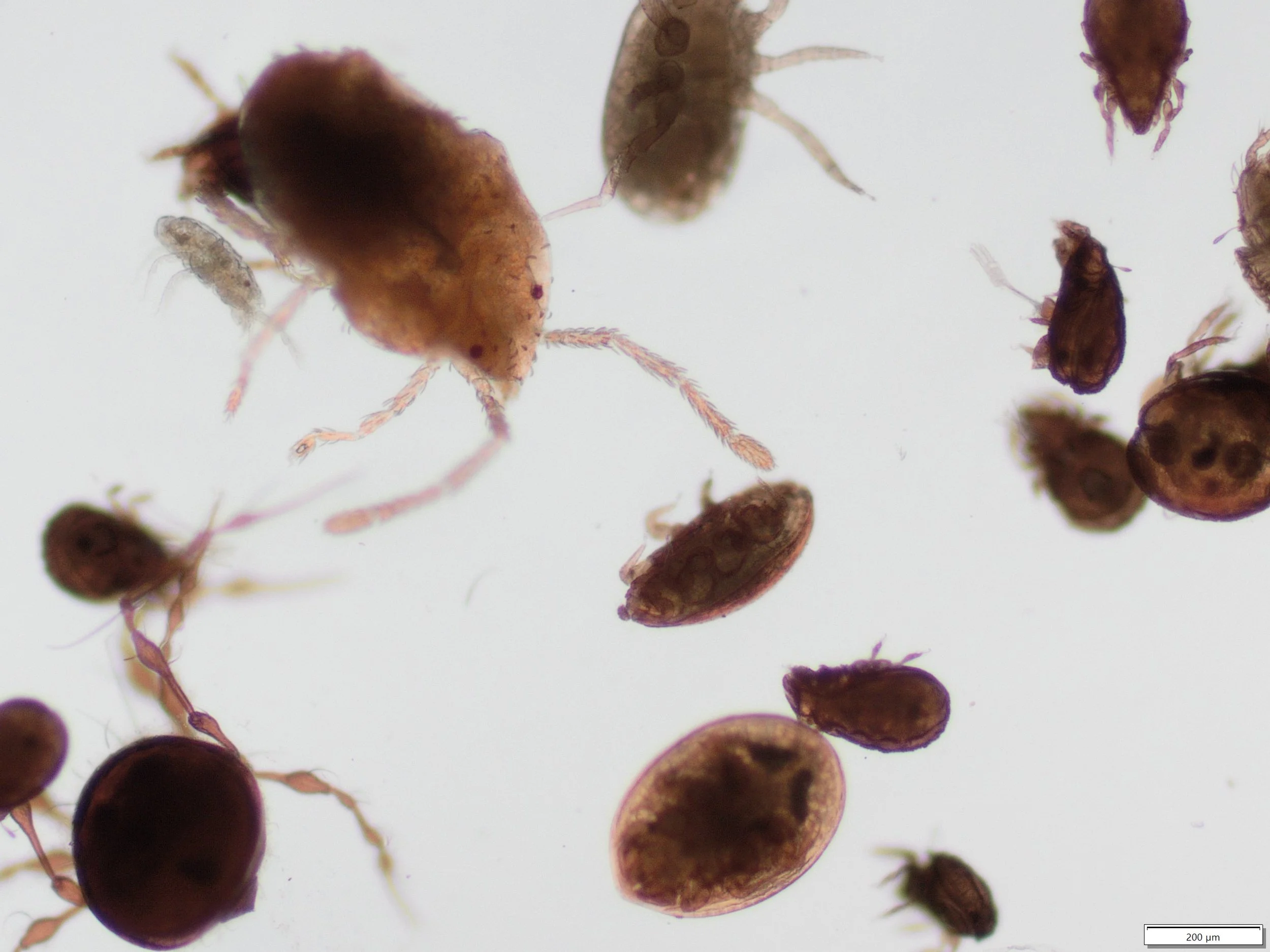
Y creo que aquí va lo bueno de lo que les quiero contar. Redoble de tambores. Yo soy acaróloga. Estudio los arácnidos más chiquitos, diversos y chistosos del planeta, algunos envidiosos dirán que son feos, pero yo creo que son super tiernos e interesantes. Me topé con ellos ya algunas lunas atrás y quedé como garrapata prendida de ellos. Estos animales me han abierto muchas oportunidades, mostrándome maravillas y caminos que nunca imaginé recorrer en mi vida como estudiante y como científica. He podido encontrarme en medio del bosque con la misma calma que los pastos sin viento y a su vez en ese mismo bosque he sentido la euforia de encontrarme con águilas reales volando sobre mí y por el suelo cientos de baiburines danzando entre mis piernas. Amo mi trabajo y aunque no faltan los días malos, siempre están los buenos donde te emocionas porque parece que encontraste una especie nueva o porque lees algo que te vuela la cabeza. Me emociona poder observar lo chiquito, tal como la frase del principito “lo esencial es invisible a los ojos”, o más bien muy chiquito, agregaría yo. Y aunque espero en otro momento poderles compartir mucho más sobre mis bichitos de estudio, esta vez se me antojó más hablar de las bichotas que me han inspirado y abierto caminos para las que vamos detrás. En la acarologia he observado un fenómeno bastante raro en las ciencias, y si he nombrado todos mis subtítulos con canciones de Shakira es porque me ha parecido apropiado precisamente alejarme de la idea de la ciencia como aburrida y seria (y es que también quedan muy bien con todo). Te invito a que visites la playlist que hice muy onda inmersiva: ttps://open.spotify.com/playlist/6AvFc0MPGDLnlZKh1PUWwk?si=fcff5c832c1a4c62
Las de la intuición
Mi primer acercamiento al maravilloso mundo de los ácaros fue cuando me encontraba estudiando mi licenciatura en biología. Para ese entonces toda rama de la biología me fascinaba y me aseguraba de estar en todos los clubes de estudiantes para conocer más. Me divertí y aprendí mucho, pero lo que más despertó mi curiosidad fue un librito escrito por la Dra. Anita Hoffman sobre ácaros, publicado en una serie de libros de divulgación científica llamados “La ciencia para todos”. Enseguida me intrigó el título “Animales desconocidos: Relatos acarologicos” y ahí quedé prendida. Inmersa en el mundo nuevo de los ácaros supe que Anita Hoffman Mendizábal fue la primera mexicana en estudiar ácaros y una de las figuras más reconocidas mundialmente por sus descubrimientos en arácnidos. A esta gran científica se le sumaron muchas gigantes aracnólogas y acarólogas, como la Dra. Guadalupe López Campos, la Dra. Magdalena Vázquez González, la Dra. Edith Estrada Venegas, la Dra. Carmen Guzmán Cornejo y la Dra. Tila María Pérez, solo por mencionar algunas. Gracias a la acarología también conocí a otros entusiastas acarólogos que me han brindado muchas porras y apoyo, inclusive a distancia como Diana Rueda Ramírez y Daysi López Baltazar, genias con un corazón gigante. A pesar de que la comunidad acarológica es relativamente pequeña en el mundo, considero que existe una alta representación de mujeres en comparación con otras ramas, como la entomología y la ecología. No solo en México y Latinoamérica las mujeres han logrado un alto nivel de reconocimiento en esta rama, ya que encontramos grandes expertas en muchos países. Por nombrar algunas bichotas en el campo de la acarología, están Heather Proctor, Yukie Sato, Zoë Lindo, Marwa Ibrahim, Valerie Behan-Pelletier, Ligia Miranda Ferreira Soares, Marjorie A. Hoy, Kaythlin Campbell, Sara Fernandes Fonseca, Mónica Farfan, que además siempre prestan su tiempo y espacio para crear redes de difusión y discusión, sin dejar de compartir experiencias y animar a más personas a descubrir esta bonita carrera. Gracias a ello, me di cuenta de que la acarología es una rama de la biología donde encuentro muchísimos ejemplos de mujeres que se parecen a mí y que aman el poder estudiar y descubrir más cosas sobre estos animalitos peculiares, controlar plagas, proteger comunidades de suelo, manejar recursos, descubrir relaciones evolutivas y erradicar enfermedades.
Loba
Me da mucho orgullo el pertenecer a una comunidad que celebra la diversidad y que tiene a tantas mujeres a la vanguardia. Un amigo acarólogo me contó una vez algo así como que la acarología es un bonito matriarcado en las ciencias y ese pensamiento siempre me hace sonreír. Es inevitable sentirse reflejada en ellas y llenarse de energía para alcanzar esos hombros. Ellas me han enseñado que las gigantas no solo se colocan en posición para que subas y veas más allá, si no que se ayudan unas a otras, que la colaboración entre todos crea cosas más chingonas y rompe paradigmas. También me hace resistir y abrirme paso, porque pertenecemos a cualquier espacio. Poco a poco seamos más, abarcando ya no el 30% en investigación mundialmente, sino más bien un 70%. No cabe duda de que la academia fue creada para los hombres por los hombres, pero vamos tomando los espacios que nos corresponden y pisando fuerte no solo en hombros de gigantas si no codo a codo con otras morras grandiosas que nos animan a seguir. Ahora veo gigantas en todas partes, en mis profesoras, en mis amigas y en estos espacios que nos permiten compartir sin dejar de ser nosotras. Porque, como la giganta Gloria Martin nos cuenta y Amparito Ochoa nos canta, la vida empieza donde todas y todos son iguales.
——————————————————————————————————————————————————————
“Standing on the shoulders of giantesses”
Pies descalzos, Sueños blancos
In science and general culture, we often hear the phrase "standing on the shoulders of giants", a metaphor coined by the philosopher Bernard de Chartres referring that we see further than our predecessors, not only by having better vision skills or a greater height, but by being elevated and supported by the knowledge previously acquired by others. This phrase was popularized thanks to a letter that Isaac Newton wrote to his rival Robert Hooke, among other phrases "... if I have seen further, is by standing on the shoulders of giants." -comment somewhat mocking in vendetta mode (according to various interpretations). I do not remember being aware of what this phrase implied for me as part of my development as student, person, scientist, and biologist. Since I was little, I took quite naturally and accepted the notion of not having female references in science and history books that were always flooded with great male brains. Geniuses, full of “Eureka!” moments in which an apple spontaneous inspiration can indicate the culmination of the scientific revelations of the century. All this while women must be only reflected on mothers, wives, students, muses or even in the most serious distractions for these giants.
Ciega, sordomuda
Maybe for this same reason is that when I heard the famous phrase, I never felt identified. I contemplated listening people say it as if was not made for me. Although I study a beautiful area that is deeply connected with nature and women, I did not have a place in the big, but exclusive giant shoulders; and that, if “de chiripa” I were to sit there, it would be more because my luck or the goodwill of mentors who would be supporting me, “despite” my condition as a woman.The truth is that for a long time I could not even mention the name of a latinoamericana scientist like me. As much as I memorized names of those women who have always existed and resisted in science despite their constant erase, when I thought of successful scientists, I could only retain names of white, European, rich and famous women, who were so far from my own reflection like those giant gentlemen… this always generated an uncomfortable frustration in me. On the other hand, the epic phrase about little people and giants seems to invite us to collaboration and teamwork, reminding us that we not only work in isolation but also that we require multiple and diverse knowledge to see more clearly and further. However, when I think of Academia, I can't help but envision a world where most people are dedicated to competing. In the corridors of science faculties, it is common to hear debates between who publishes more, has more funds, more students, more team, more hierarchy, more credit, more relevance. Ironically, the same case is observed in the use of this phrase, supposedly, in a letter to ridicule one another.
Te felicito/ Donde están los ladrones
What I discovered after digging a bit (perhaps in search of representation that made me feel less alone) was that we have always been there despite the deletion of women in history, not only very much present, but all this time, we have been pioneers, witches, geniuses, always putting ourselves there, even if they take us away and always screaming to be heard, even if they silence us. Just taking an example within the historical context in which the phrase of standing on giants was popularized, we come across, among millions more, the brilliant Emilie du Chatelet. Emilie critically corrected our uncle Newton's formula for mass velocity, among other important contributions. This even took a hundred years for the scientific community to accept, because was from a woman. Her work was a key piece of Einstein’s inspiration for future discoveries (insert bizcochito-Rosalía intro, here). There are so many cases of discrimination and theft of achievements from women that we created terms such as the ceiling glass and the Matilda effect, about prejudice and the crediting of their scientific discoveries to men, whether they were coworkers, husbands, mentors, or directors. Many cases even sound ridiculous or seem to be taken from a horror story. Even so, today these cases abound, and the stories of struggle and resistance of these women are still missing in schoolbooks and most of the classrooms.
Sale el sol
And I think here is goes the good part of what I want to tell you. Drumroll. I am an acarologist. I study the smallest, most diverse and funniest arachnids on the planet, some envious will say they are ugly, but I personally think they are super cute and interesting. I ran into them six years ago and I got obsessed with them like a tick. These animals have opened many opportunities for me, showing me wonders and paths that could I never imagined I would walk in my life as a student and scientist. I have been able to find myself in the middle of the forest with so much calm as the windless pastures and at the same time, in the same forest I have felt the euphoria of meeting golden eagles flying above me and hundreds of baiburines (chiggers) dancing between my legs on the ground. I love my job and although there are always bad days, there are always good days where you get excited because you found a new species or you read something that blows your mind. It excites me to be able to observe the small, such as the phrase of the little prince " what is essential is invisible to the eyes" or rather very small, I would add. I hope at another time I will be able to share much more about my bugs or bichitos, this time I wanted to talk more about the women that have inspired me and opened paths for those of us who are behind. In acarology I have observed a rather rare phenomenon in the sciences, and if I have named all my subtitles with Shakira songs it is because it has seemed appropriate to me precisely to move away from the idea of science as boring and serious (and it is that they also fit good with every chapter).
Las de la intuición
Although the acarological community is relatively small worldwide, I consider that there is a higher representation of women compared to other disciplines, like entomology and ecology. Not only in Mexico and Latin America women have achieved a high level of recognition in this carrer, since we can find experts in many more countries. To name only a few of top scientists in the field of acarology, I can mention Heather Proctor, Yukie Sato, Zoë Lindo, Marwa Ibrahim, Valerie Behan-Pelletier, Ligia Miranda Ferreira Soares, Marjorie A. Hoy, Kaythlin Campbell, Sara Fernandes Fonseca, Mónica Farfan. These women are our giants. In addition, they always make time and space for students and other fellow acarologists, and they believe in creating networks of collaboration and discussion, while continuing to share their experiences encouraging more people to discover this beautiful group of study. Thanks to this, I realized that acarology is a branch of biology where I can find many examples of women who look like me and who love to study and discover more about these peculiar little animals, how to control pests, protect soil communities, manage resources, discover evolutionary relationships, and eradicate diseases.
Loba /She Wolf
It makes me so proud to belong in a community that celebrates diversity and has so many women at the forefront. An acarologist (male) friend once told me something like “Acarology is a beautiful matriarchy in the sciences” and that thought will always make me smile. It is inevitable to feel reflected in them and fuel yourself with energy to reach those shoulders. They have taught me that the giantesses not only position themselves for you to go up and see further, but that they help each other, that collaboration between everyone creates greater things and breaks more paradigms. It also helps me to resist and navigate my own academic journey, because we belong to any space. Little by little we are more, covering no longer 30% in research worldwide, but rather 70%. There is no doubt that the academy was created for men by men, but we are taking the spaces that correspond to us and stomping not only on the shoulders of giantesses but also side by side with other great girls who encourage us to continue. Now I see giantesses everywhere, in my teachers, in my friends and in these spaces that allow us to share without ceasing to be us. Because, as the giant Gloria Martin tells us and Amparito Ochoa sings to us, la vida empieza donde todas y todos son iguales (life begins where everyone is equal).